7 min read
Pot a Rooted Pilea Pup Without Stripping the Parent
Find a rooted basal shoot, lift it with a little of its own mix and keep both containers in useful light after division.
On this page
When a Chinese money plant starts producing smaller plants around the rim, it can be difficult to tell where one ends and the next begins. A leafy shoot beside the stem may be rooted in the soil, or it may rise from a part of the main plant you cannot yet see. Take a look at the base before cutting. You can move one well established pup into a modest pot and leave the youngest growth where it has support. This keeps the parent useful and gives the new plant a much simpler start.
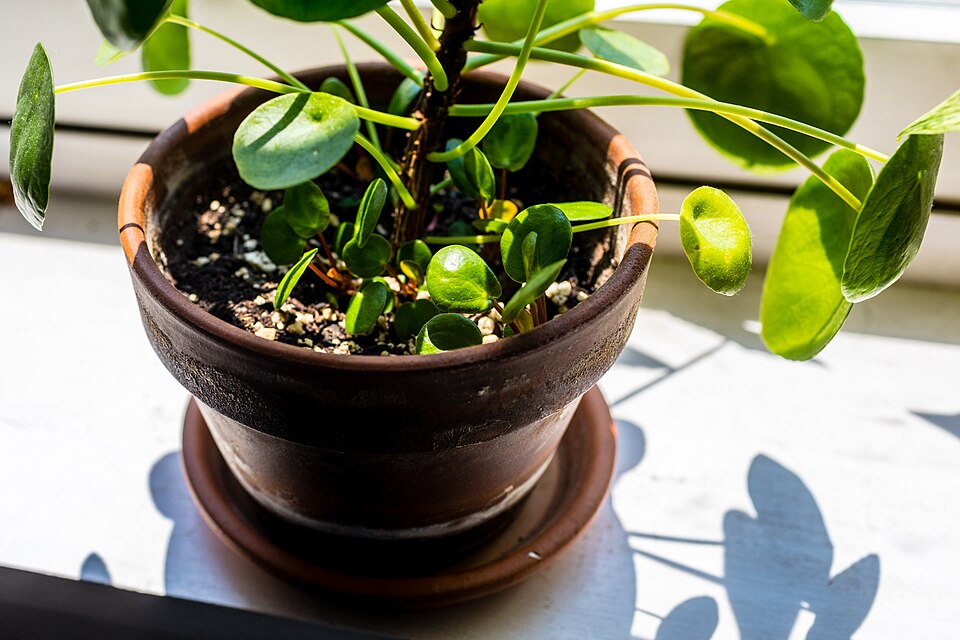
Pilea peperomioides forms round, shieldlike leaves on long stalks. A healthy mature plant can develop several shoots from near the base. Some growers prefer the shape of a tall single plant and others like a fuller pot. Choose which outline you want before removing every shoot. Young shoots often emerge in the pot close to the base of the parent plant. A visible leaf on a small shoot is a good reason to look closer, and the root system will help decide whether it should move.
Keep a few shoots where they serve the shape
Set the pot in good light and look down into it. Trace each large leaf stalk back to the main stem. Then look for a cluster of several leaves emerging separately at the soil line. A young shoot close to the rim may have more independent root growth than one high on the side of the parent stem. Pick a shoot that you can reach without bending the main plant severely. A small patch of open soil beside it will make a controlled separation much easier.
Decide whether you want to preserve a full mound or a taller single silhouette. If the central stem is becoming bare, a healthy basal shoot can make the pot look fuller and can stay attached. If two strong shoots overlap or one has reached a point at which the root area dries unusually fast, consider moving just one. The first choice is not about whether the pot is tidy. It is about keeping healthy growth in a place where you can water and see it.
Give the parent the conditions to support healthy new growth. Bright indirect light is a useful choice, with strong direct sun moderated when necessary. A steady pot in good light is easier to judge. Check the underside of older leaves and the base for visible pests or decay before propagating. If the main plant is experiencing a problem, identify it before handing a shoot to somebody else. A strong parent with several sound leaves can give up one pup much more readily than a plant already losing most of its foliage.
Look for independent roots
Gently move a little loose mix from beside the pup. Try using a narrow smooth tool or your fingertips. Avoid pulling on the young leaves to see whether it comes away. Follow the junction just far enough to see whether the small plant has roots attached or can be lifted with a small root ball. A branch that arises higher on the main stem is a different sort of cutting from a root-bearing offset. For this simple method, leave the higher or still very small shoots alone. Wait until there is a sound basal one you can separate.
If the roots are difficult to inspect because the pot is crowded, check whether the entire root ball can be eased out intact. Support the main stem near its base while holding the soil mass from below. Work on a stable surface and move only the amount of loose medium needed to distinguish the roots. Choose a small part you can lift with living roots and intact stems. Put the plant back if you find the shoot is too close to the middle or pulling it would damage the largest part of the parent.
Prepare a small drained pot before making a cut. Use a loose appropriate houseplant mix and keep the working surface clean. Where a thin attachment needs severing, use clean sharp tools and retain useful roots with the new plant. Lift it carefully with a little of the original medium. A handful of leaves completely separated from its roots is a different start from the one you planned. Set the main plant down and re-cover exposed roots promptly. Leave the parent's stem at its previous level.
Use a pot that matches the young root area
Set the small shoot into the new medium at the level it grew before. Leave its foliage and growing point clear. Settle mix around the roots so the plant stands without forcing soil around the stem. Water enough to settle the root area as appropriate and let the pot drain. A very small pup in a large decorative planter may sit in a volume of wet mix it cannot yet use. A modest nursery pot inside an accessible cover can make it easier to judge what happens as the new roots grow.
Give both containers bright indirect light and avoid a sudden move into hot sun. Check the small pot often enough to learn how it dries, while allowing air to return to the mix. Water when it is needed and drain it. Do not keep it continuously wet simply to encourage rooting. A rooted pup is still adapting to the new mix. The original root ball and the fresh material around it can dry at different rates. Feel both, then water the part of the root zone that needs it.
Label the pup with its date. A leaf may remain firm for some time without a new one appearing. Look for fresh growth and whether the plant is seated after a period of appropriate conditions. Do not lift it repeatedly to inspect roots. If it is still upright and leaves remain intact, give it time. A plant with soft lower tissue in soggy soil needs a drainage and root inspection rather than another drink. Compare with the parent only after remembering that the two pots have different amounts of roots and volume.
Keep the parent’s rim clear after lifting a pup
Look at the opening left by the small plant. Fill any depression around the parent's roots with loose suitable mix to its earlier level. Settle gently and keep its base above it. The fresh space makes it easier to see where water goes and whether other shoots are expanding. If the rest of the pot remains firm and has a useful drying rate, do not assume it needs a large repot just because you removed one shoot. Let its new leaves show how it handles the change.
Inspect the inside of the cover pot the next time you water. Water that stays below the nursery pot can be missed when a cluster of leaves conceals the rim. After watering, allow proper drainage and empty the cover or saucer. Keep the young pot separate if its watering checks are entirely different. A matching pot pair is visually appealing, but there is no practical need to water both together while one small root system is still entering its new medium.
Compare the two newest leaves after several weeks
Watch a leaf from the pup and one from the parent that open after the separation. Note their firmness and how far the stalk reaches. Make the comparison in similar positions: a pup kept farther from the window may lean or stretch even when it received proper root care. Give it useful daylight during active growth and keep the same clear distance from heating or cooling vents. A modest change in position can help new leaves form with less reach.
The parent can keep its old shape while the pup develops differently. Avoid lifting it again to correct that difference if both plants are growing well. If you plan to separate another one, wait for a suitable period of active growth, commonly spring or early summer. That gives the rooted section a better opportunity to develop in its own pot.
Choose what to share when growth is steady
Once a new plant makes a few normal leaves in its own container, decide where it should grow. A bright shelf with a clear drainage routine gives it a predictable start. A suitable gift should have a firm root area and a straightforward label. Tell the recipient how the young plant was grown and how you checked moisture rather than promising a fixed watering day. If you prefer to keep it, let the next leaf guide placement and avoid moving it to a bigger pot before the roots use their current room.
Take another look at the growing parent a few weeks later. If the main pot is still accessible and new shoots appear, decide which ones you will keep for shape and which could become a second division later. You can wait until there is another clearly rooted pup. A single healthy offset in its own pot shows that you did not need to disturb all the growth at the base to make a new plant.
Further reading: NC State Extension profile of the Chinese money plant.